


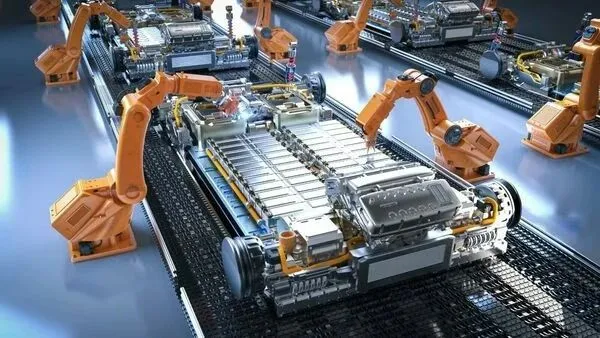
For decades, the story of India’s economy was told in software and services. The factory floor was someone else’s business – mostly China’s. That story is quietly being rewritten. In July 2026, India shipped USD 44.24 billion of goods to the world in a single month, up from USD 36.98 billion a year earlier. Manufacturing output that same June grew 7.8%. These are not the numbers of a country waiting its turn. They are the numbers of a country that has already started running.
The scaffolding behind the momentum is now visible. Manufacturing contributes 16-17% of GDP and employs more than 27 million people, and its value added has compounded at nearly 11% a year since 2022-23. But aggregate figures rarely convince anyone. The real case for India’s manufacturing decade lives in the individual sectors – and there, the evidence is startling.
The phone in your hand tells the story
Start with the most intimate example: the smartphone. In 2014-15, India assembled roughly ₹18,000 crore worth of mobile phones and exported almost nothing – about ₹1,500 crore. A little over a decade later, mobile production has reached ₹6.27 lakh crore, a 33-fold jump, and exports have exploded 165 times over to ₹2.59 lakh crore. Today, 99.2% of the phones Indians use are made in India, and the country has gone from importer to net exporter, now the world’s second-largest phone manufacturer by volume.
Zoom out to the whole electronics ecosystem and the trajectory holds. Production has grown seven-fold since 2014-15 to ₹13.11 lakh crore; exports are up eleven-fold to ₹4.24 lakh crore. And the government is now reaching for the hardest, highest-value link in the chain – semiconductors. The Semicon 2.0 programme, cleared in July 2026 with a ₹1,27,500 crore budget, builds on an earlier ₹76,000 crore push. Twelve chip units carrying over ₹1.64 lakh crore of investment have been approved, and three – Micron, Kaynes and CG Semi – are already in commercial production. A country that made almost no chips is learning to make the thing everything else depends on.
From importer to armourer
Nowhere is the shift more symbolically powerful than defence. For most of its independent history, India was the world’s largest arms importer, a strategic vulnerability dressed up as necessity. In 2013-14, the country exported ₹686 crore of defence equipment. In 2025-26, that figure was ₹38,424 crore – a rise of more than 5,500% in twelve years, with Indian-made systems now going to over 80 countries. Domestic defence production has nearly quadrupled to ₹1.78 lakh crore, and crucially, the private sector now accounts for 24% of it, evidence that this is an industrial base broadening, not just a state enterprise expanding.
The old strengths, scaled up
India’s manufacturing revival is not only about new frontiers; it is also about finally scaling the sectors where the country was always meant to win.
Pharmaceuticals is the clearest case. India is already the world’s third-largest drug producer by volume and supplies a fifth of all generic medicines on earth – the pharmacy of the developing world. The sector turned over ₹4.72 lakh crore in 2024-25, and targeted incentives worth ₹25,360 crore have pulled in nearly ₹52,000 crore of fresh investment, seeding domestic capacity for 218 critical drug ingredients the country once imported. Medical device exports have climbed from ₹26,915 crore to ₹42,360 crore in five years. The next bet, a ₹10,000 crore Biopharma SHAKTI mission, aims to move India up the value chain from generics into cutting-edge biologics.
Textiles tells a parallel story of scale meeting ambition. The industry employs over 45 million people – second only to agriculture – contributes 11% of manufacturing value added, and exported USD 37.7 billion in FY2025, making India the world’s sixth-largest textile exporter with a 4.1% share. This is a country that grows more cotton than any other and exports more cotton yarn than anyone else. NITI Aayog’s roadmap sees the next leg coming from technical textiles, man-made fibres and premium weaves – moving from volume to value.
Automobiles complete the picture of a maturing industrial base. Production rose from 22.65 million vehicles in FY21 to 31.03 million in FY25, and India is now the world’s largest maker of two- and three-wheelers and third-largest in passenger and commercial vehicles. The sector supports over 30 million jobs. A ₹25,938 crore incentive scheme has already drawn ₹44,326 crore of investment, while the ₹10,900 crore PM E-DRIVE programme is electrifying the fleet – 14,000 electric buses deployed, incentives flowing to some 28 lakh EVs – positioning India to lead the next technology cycle rather than import it.
Building the things that build everything
The most telling signal of intent is where the government is now placing bets: on the deep, capital-heavy industries that decide whether a manufacturing power is real or borrowed.
Consider shipbuilding, an industry India had all but ceded. In September 2025, the government committed a ₹69,725 crore maritime package – a ₹19,989 crore shipbuilding scheme targeting 4.5 million gross tonnes of annual capacity, a ₹25,000 crore development fund, and a ₹10,000 crore container programme meant to raise domestic capacity ten-fold to 7.5 lakh containers a year. The proof of concept arrived in July 2026, when India delivered its first domestically manufactured export container to shipping giant A.P. Moller-Maersk. A country that imported virtually all its shipping containers had just sold one to the world.
Then there is solar, where India’s numbers verge on the improbable. Domestic module manufacturing capacity has grown from 2.3 GW in 2014 to 100 GW by August 2025 – a more than forty-fold expansion. Solar cell capacity, the harder upstream step, has gone from under 1.2 GW to 25 GW. Exports in FY25 ran eight times higher than FY18. With a ₹24,000 crore incentive pool and a market growing 17-20% a year toward a 280 GW target, India is building the hardware of its own energy transition instead of buying China’s.
Why the story holds together
Any single one of these numbers could be dismissed as a subsidy-fed spike. What makes the manufacturing story credible is that they rhyme. The same pattern repeats across phones, chips, defence, drugs, ships and solar: a low base, a policy push aimed not at output alone but at value addition and localisation, private capital arriving to match public intent, and – critically – exports rising alongside domestic production. That last point matters most. Subsidies can inflate a domestic market; only competitiveness wins export orders. India is winning them.
NITI Aayog’s own framing is instructive. Its report on positioning India as a global manufacturing hub studies four sectors in depth and promises eight more to come – a signal that this is a structured, multi-year industrial strategy, not a slogan. The through-line is a shift from assembling other people’s designs to owning the value chain: feedstock in chemicals, components in electronics, ingredients in pharma, cells in solar.
None of this guarantees the outcome. Infrastructure gaps, skilling shortfalls and global trade headwinds remain real. But the direction is no longer in doubt. A decade ago, “Make in India” was an aspiration. The data now reads like a description. The factory has awakened – and the rest of the world is beginning to place its orders.
At Manek Financial, we believe in India’s manufacturing story – not as a slogan, but as one of the defining investment opportunities of this decade.